– And how to not lose sight to your competitors when everyone can use AI and automation
SEO is not the same as it was in 2019 when i started. The SEO work consisted of manual work: searching for keywords in different keyword tools, mapping keywords and deciding what keywords should belong to what page, optimizing titles and descriptions by adding keywords to them, doing manual competitor research to see how the content looks like that is ranking in top of the search results, creating content briefs for your copywriters, you have another copywriter writing the article or page content according to your instructions. You might build some backlinks to your article if the competition is strong, and you might find 5-7 pages on your website from where to link to you article. The technical SEO has stayed the same more or less.
This is how SEO used to look like, and it still kinda works. There are just a few ‘but’s.
This content piece is written by Katarina Dahlin on september 9th around noon in the airplane on her way to Sofia, Bulgaria for an SEO conference. No wifi on the airplane, where as the content is 100% human-written, with her current thoughts about SEO in 2026 and how to win.
SEO in 2026: AI, automation and AI search
We have AI tools today that make the work much faster, and they are good enough today in 2026 to make this same SEO work high quality. At least those who can use the AI tools, and I dont mean writing shit content now). The same work can now be done 10 x or 100 x faster. And you can save on resources. If you train your AI agents and review their work.
I claim that if you still in 2026 try to do SEO the same manual ways as described in my intro, you will fall behind. You will be doing in slow speed. That is okey for me. But there will be guys (and not only me) who will learn to use AI and AI agents, and they will scale their quality work, scale content, scale resources. They will rank on more keywords, they will be more visible in AI searches, they have more time to put on the important work, strategy. Those guys, those brands, will will in search 2026. It is better in 2026 to be fast with 90% good content than use endless time to make one content piece 100% good.
There is also this thing called AI search nowadays (didnt exist in 2019), and optimizing for that is called (GEO, AEO, SGE, AI search optimization and what not, but it doesnt really matter to be honest what it is called). But the thing is, searches are moving there, the use of AI tools are increasing, no one has time to google anymore, people ask directly in AI tools, and if you Google, AI Overviews and AI mode is free to use, and they have become quite good nowadays for certain direct answers and informational queries. If your brand is not visible in the AI searches, when potential new customers are looking for solutions to problems where your product or service would be the solution, you don’t exist, you will not be in their minds.
There is also this other thing when AI cites your page as a source in the AI Overviews, in AI mode, in ChatGPT, in Claude, in Copilot and in whatever AI tool you use. Here AI might not mention you as a brand, but AI might use information on your page as a source in its answer, and then add your site as a source in the answer. When the user wants to know more or read more, they can click and visit your website. This is called LLM traffic. You still want traffic to your website, doesnt matter if it comes from AI tools, google or paid ads. You will not get them as easily as before from Google organic though.
So, how to win in search today?
The recipe is simple, and it still follow the same old rules:
Create good content that matches the search intent where users stay after clicking from Google, publish it on an trustful site that has authority (build links, get brand mentions and create brand searches), make sure your website is technically working, fast and readable to Google and AI bots in case it uses a lot of Javascript.
It is simple but requires work, as you can see the answer is longer than 3 words.
And how to be fast enough with content and still get it to rank?
I’ll give you an example of my SEO research and content workflow.
As i am optimizing my own website katarinadahlin.com I created my technical SEO content cluster this weekend, consisitng of 8 articles. Before that I had one piece published already, my technical SEO guide, so I was ranking on quite many tehcnical keywords already in search console, but I identified this to be good to continue on, as I want to be visible on high intent searches like “tehcnical SEO expert” or “technical SEO audit” in finnish. Also I believe, if you cover a topic as a whole, not just write single random pieces within a topic, google will reward you with good rankings. This is what I did:
- I have build my AI content writer agent for my website, and connected with MCP all SEO tools I use to the AI agent: Search console (to identify on what keywords I rank today), Data for seo (to find new keywords), Surfer seo and AI visibility tracking tool (to help with SERP analysis, content clustering, AI visibility data).
- I pulled the keywords that I am ranking on in regards to technical SEO from Search console
- I asked my AI agent to do a SERP analysis and analyse what content and articles I need to cover most of the technical seo related keywords from Search console, and also find new related keywords. I asked the AI agent to use the Surfer tool when possibly as it saves 5 x more tokens than web searches in Claude does. It suggested 8 articles.
- I also asked the AI agent to use all fanout queries it could find in the technical SEO topic that I also follow in Surfer AI visibility tool. The goal here is to increase the likelyhood to get my articles cited as a source in LLMs.
- When writing the articles, I have certain instructions how I want them to be to also here increase the possibility to get them cited in AI searches. Some of the instructions are:
a. BLUF (Bottom Line Up Front writing method, say the most important things in the first 50 words of the article. This is the answer you want to get into AI searches)
b. Chunk Optimization (write in chunks, so pieces can stand on their own in the article
c. Cost of Retrieval (write clear answers, no fluff) - I upload my own materials I have about this topic, videos, presentations, checklists, to get what I want to say into the article and not jsut scrape knowledge from the web. This makes the content more personal and unique.
- Finally I ask to write the articles for me, and I also use Surfer’s content optimization tool, because I like it. The article gets upload there throguh Surfer MCP, where I review it, and make my own edits, add images and videos, and finally publish it on my wordpress site.
Results
As my website is quite strong with backlinks I accuired, and the content is good enough, and I have a personal brand though off site activities and brand searches. Many of the articles got into the AI Overviews and AI mode, and also in top 3 in Google SERPs, and ranking on SEO terms are not always so easy when every search enginge optimizer is trying to rank as well and know one thing or two about SEO 🙂
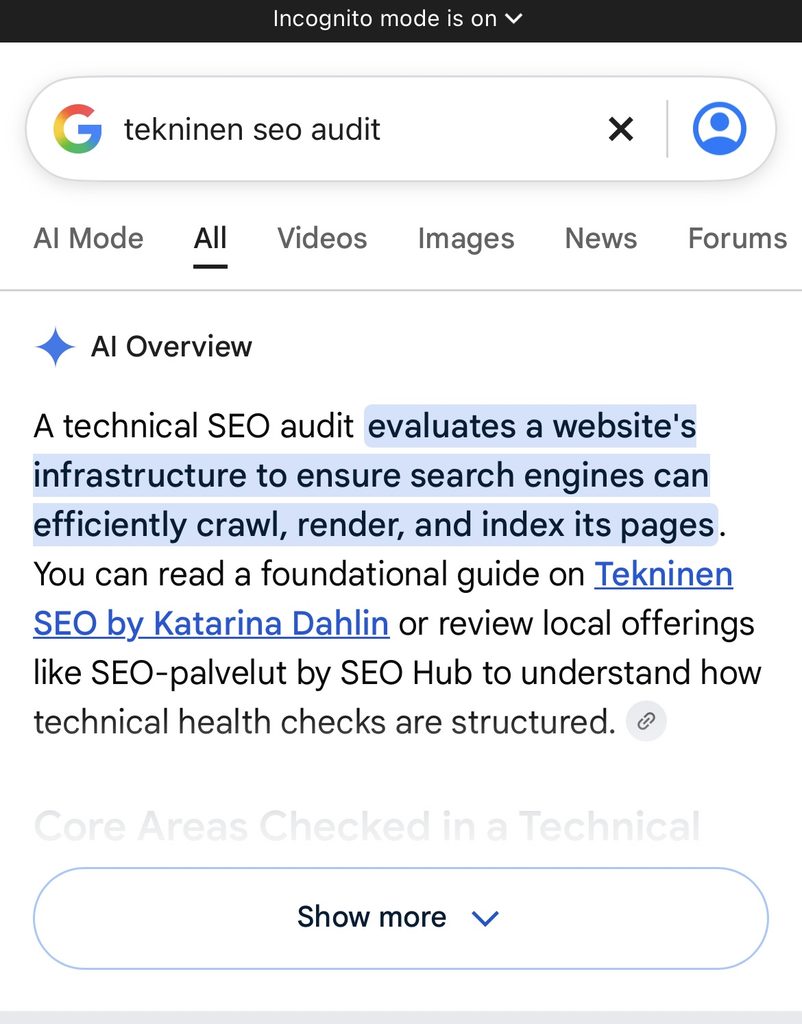
I will upload some more screenshots of results when I land. But managed to check these finnish SERPs while in Helsinki.
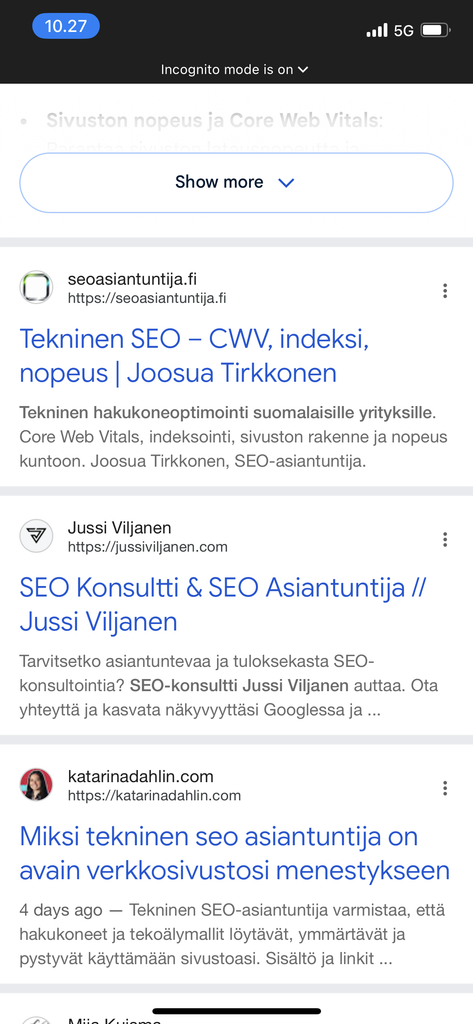
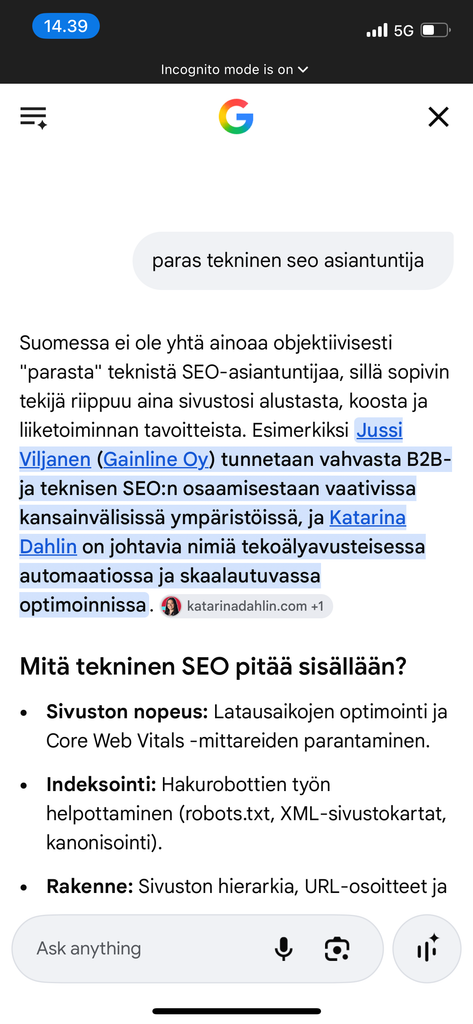
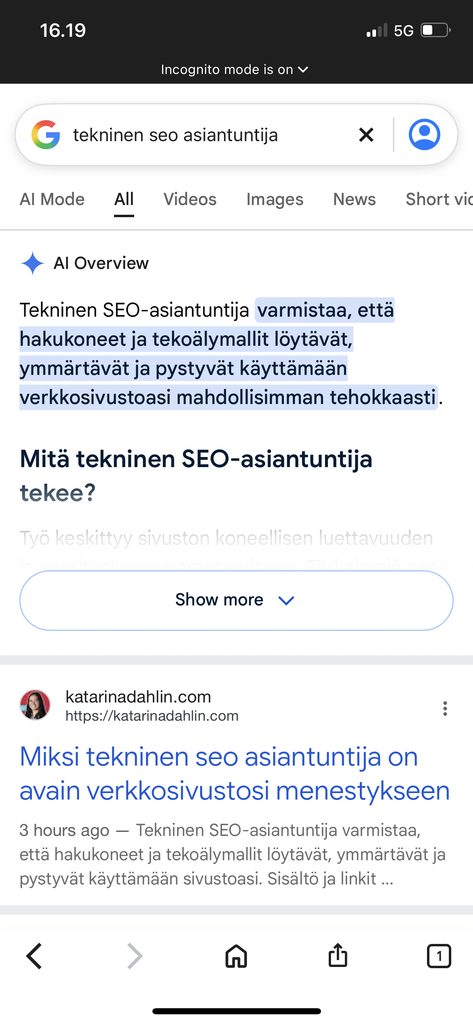

Need my help in Google and AI visibility?
I help clients on the Nordic markets to rank higher in Google, and become visible in AI search, with proven AI and SEO strategies. If you want my help or have questions, feel free to write to me.
